
Pharma teams ask the same question again and again: which patents stand between us and a product, and what do they actually protect? A patent intelligence platform exists to answer that without weeks of manual reading. This guide explains what such a platform does, how ready-made and custom tools differ, and what to check before you choose one.
Note: patent intelligence software supports analysis. Conclusions on validity, infringement or freedom to operate should always be made with a qualified patent attorney.
1) What a patent intelligence platform does
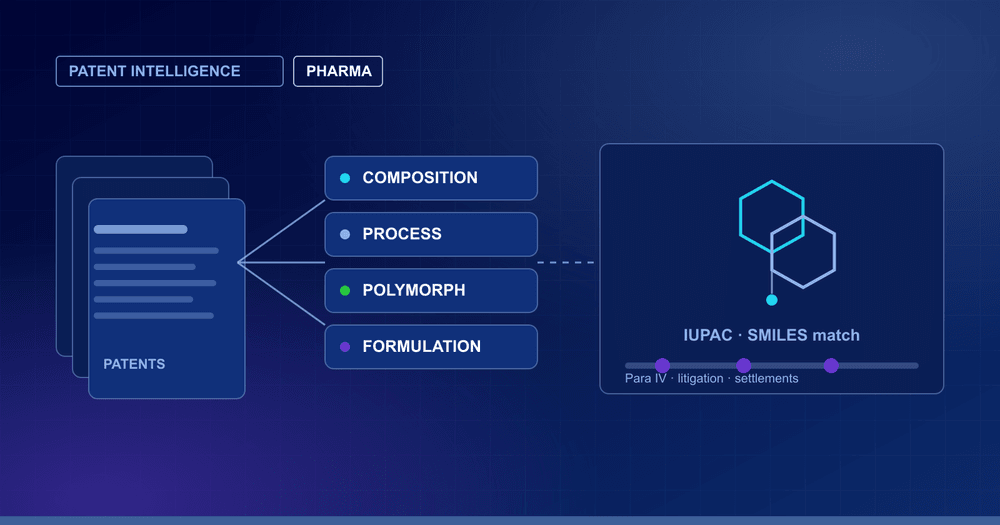
At its simplest, the platform collects patent data, connects it to your products, and shows it in a form your teams can act on. In practice that means:
- Collecting patents from patent offices such as the USPTO, the EPO and national offices.
- Reading the claims, not just the title and expiry date, so you can see what each patent really covers.
- Mapping patents to products, so a molecule or product shows the patents that relate to it.
- Tracking legal activity, such as Para IV challenges, litigation and settlements.
- Presenting it in dashboards for Business Development, Regulatory Affairs, R&D and senior management.
2) Why the expiry date alone is not enough
A headline expiry date says when a patent ends. It does not say what the patent protects. Two patents on the same product can matter very differently depending on their claims, for example:
- Composition claims that cover the molecule itself.
- Process claims that cover how it is made.
- Polymorph claims that cover a particular crystal form.
- Formulation claims that cover how it is delivered.
- Method-of-use claims that cover a particular treatment use.
Understanding claim scope is what lets freedom-to-operate and NPD decisions rest on what a patent covers, not on a date in a table.
Quick win: for your five most important products, list the patents you rely on today and note which claim type each one is. Gaps in that list show where manual tracking is already failing.
3) Ready-made platform or custom-built tool?
There are two routes, and neither is right for everyone:
- Ready-made commercial platforms are available immediately and work for general needs. Their data model, screens and terminology are fixed, so your team adapts to the tool.
- Custom-built tools are designed around your own workflow, terminology, products and data sources. They take longer to set up, but the tool adapts to your team.
A custom tool makes most sense when your workflow is specific, when you need patent data joined with your own NPD, regulatory or sales data, or when you want the output to feed your ERP, PLM or BI systems.
4) Checklist: what to look for in a patent intelligence platform
- Does it read and chart claims one by one, instead of relying on titles and expiry dates?
- Does it separate composition, process, polymorph, formulation and method-of-use claims?
- Does it map patents to products using structure matching (IUPAC names and SMILES) rather than keyword search?
- Which patent offices does it cover: USPTO, EPO and the national offices you care about?
- Does it track Para IV challenges, litigation and settlements, so you can assess first-to-file opportunities?
- Can you see why a patent was linked to a product, so a person can check it?
- Do different teams get role-based views of the same data?
- Can it connect to your ERP, PLM or BI tools, and who owns and hosts the data?
5) Common pitfalls when choosing a platform
- Choosing on the number of patents covered: a big database that your team cannot filter or read at claim level creates more manual work.
- Trusting keyword matching: products and molecules are described in many ways, so name-based matching can miss patents or link the wrong ones.
- Treating the output as a legal opinion: software narrows the reading; an attorney still decides.
- Keeping the old spreadsheets: if teams still maintain their own trackers, the platform becomes one more source of truth to reconcile.
- Ignoring who will use it: a tool built only for patent specialists will not be used by Business Development or management.
6) Questions to ask any vendor, including us
- Which data sources and offices do you cover, and how often are they refreshed?
- Can the tool follow our terminology and our own approval steps?
- Where is the data hosted, and who can access it?
Talk to us about patent intelligence
Kelectron builds custom pharma software, including patent intelligence and claims mapping: NLP-based claim parsing and charting, patent-to-product mapping using IUPAC names and SMILES structure matching, and Para IV, litigation and settlement tracking, fed from USPTO, EPO and national patent office data. If you are comparing platforms or tired of tracking patents by hand, describe your workflow and we will tell you what a custom tool could look like. See our Pharma Intelligence service, read how we approach NPD tracking, or contact us.
Common questions
What is a patent intelligence platform for pharma?
It is software that collects patents from patent offices, reads their claims, maps them to your products and tracks legal activity such as Para IV challenges, litigation and settlements, then presents the result in dashboards for each team.
What should pharma companies look for in a patent intelligence platform?
Claim-level reading rather than expiry dates alone, product-to-patent mapping that uses structure matching (IUPAC names and SMILES) instead of keyword search, coverage of the patent offices you need, Para IV, litigation and settlement tracking, and role-based dashboards.
Why is a patent expiry date not enough?
An expiry date shows when a patent ends, not what it protects. Composition, process, polymorph, formulation and method-of-use claims can matter very differently, so freedom-to-operate and NPD decisions should rest on claim scope.
Does patent intelligence software replace a patent attorney?
No. The software speeds up collecting, reading and organising patent data, but conclusions on validity, infringement or freedom to operate should be made with a qualified patent attorney.
Can Kelectron build a custom patent intelligence tool?
Yes. Kelectron builds custom pharma software with NLP-based claim parsing and charting, patent-to-product mapping using IUPAC names and SMILES matching, and Para IV, litigation and settlement tracking, built around your own workflow and terminology.