
Choosing an industrial automation company is a decision you will live with for years. The right partner helps your machines run longer, your team see problems earlier and your energy bills fall. The wrong one leaves you with a system nobody uses. This guide explains what to decide first, how to compare companies, and which questions to ask before you sign.
1) Start with the problem, not the technology
Most projects go wrong because they start with a product (“we need IoT” or “we need a PLC upgrade”) instead of a problem. Before you speak to any company, write down what is hurting production today:
- Unplanned downtime: machines stop and nobody knows why or for how long.
- Low or unknown efficiency: you cannot say how much of the day each machine is really productive.
- Breakdowns without warning: maintenance is reactive, not planned.
- High energy cost: you see one monthly bill, not what each machine uses.
- Manual reports: supervisors collect numbers by hand, so data arrives late and is easy to get wrong.
Quick win: pick the one problem that costs you most and write one sentence about it, for example “Line 2 stops several times a shift and we do not record why.” A good company will start from that sentence.
2) Know which kind of partner you need
“Industrial automation company” covers very different businesses. Knowing the type saves you from comparing the wrong quotes:
- Equipment and panel suppliers sell and install PLCs, drives, panels and machines. They are strong on the physical side of the plant.
- System integrators design and commission whole automation lines, usually around one brand of control equipment.
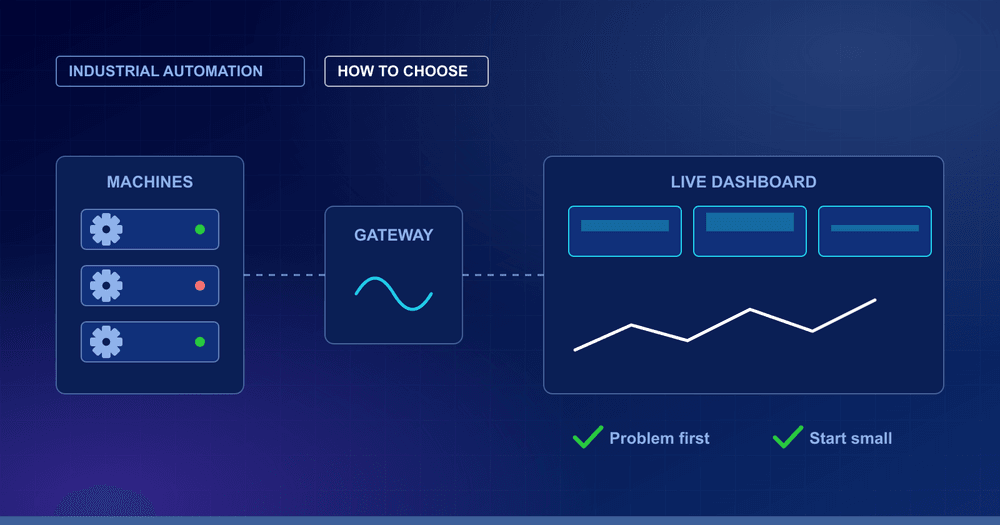
- IIoT and software partners connect the machines you already have to sensors, gateways, a cloud platform and dashboards, so you can see and act on the data.
Many plants need more than one. If your main problem is visibility, such as downtime, utilisation or energy use, you may not need to replace any machine. Monitoring software on top of the equipment you already run can be enough to start.
3) What a good partner should be able to show
- Real projects with real results, described clearly, not only a list of logos.
- A clear explanation of how the system works, from the sensor to the dashboard, in words your team understands.
- Experience with equipment like yours, including older machines that were not built to be connected.
- People you can reach: engineers who answer questions before the contract, not only sales staff.
- Honest limits: a good partner tells you what is not worth automating.
4) Checklist: questions to ask any automation company
- Which problem will you solve first, and how will we measure that it is solved?
- Can you show a similar project, and what changed for that customer?
- Do we need to replace any machines, or can you connect the ones we have?
- Which sensors, PLCs and communication protocols do you work with?
- Who sees the data, and does it work on web and mobile?
- Can it connect to our ERP system for production planning?
- What alerts will our managers receive, and how (SMS, email, app)?
- Who owns the data, and where is it hosted?
- What support do we get after the system goes live?
- How do we start small and expand later?
5) Check how it connects to what you already have
A new system rarely arrives on an empty factory floor. Ask how the company handles what you already run:
- Existing machines: sensors and PLCs can capture data from legacy equipment, so machines do not have to be replaced to appear on a dashboard.
- Communication: gateways send data to the cloud over standard protocols such as MQTT and HTTP.
- Business systems: production data is most useful when it can feed your ERP system.
- Wired or wireless: wireless sensors can cut cabling cost, but the right choice depends on your plant layout.
6) Common pitfalls when choosing a company
- Choosing on price alone: the cheapest quote often leaves out integration, training or support.
- Buying features you will not use: dozens of screens are no help if your team needs three clear numbers.
- Starting with the whole plant: a big first project is slow to finish and hard to learn from.
- No owner on your side: someone in your team must decide which data matters and act on it.
- Ignoring the people on the floor: if operators and supervisors do not trust or use the system, it will not help.
- Unclear data ownership: know who owns your production data and how you can get it out.
7) How to start without a big project
- Pick one line or a few machines where the problem is clearest.
- Measure first: record availability, performance and downtime reasons for a few weeks, so you know the real starting point.
- Act on what you learn, then add more machines, alerts or energy monitoring step by step.
Example: in one Kelectron deployment, real-time monitoring on a multi-line factory reduced machine downtime by 22% in the first 60 days. In another, visibility across more than 20 energy meters lowered peak load by 18%. Both started from live data, not from replacing equipment. Read the details in our smart manufacturing case study and energy monitoring case study.
Talk to us about your plant
Kelectron Technologies is an industrial automation and IIoT company based in Rajkot, Gujarat, India. We build the sensors, gateways, cloud platform and dashboards end to end: machine utilisation and OEE, downtime analysis, preventive maintenance, energy monitoring and remote control, with optional ERP integration. If you are comparing companies, describe your plant and the problem you want to solve, and we will give you an honest view of where to start. See our industrial automation service or contact us.
Common questions
How do I choose an industrial automation company?
Start with the production problem you want to solve, decide whether you need equipment suppliers, a system integrator or an IIoT and software partner, then compare companies on real project results, how they connect to your existing machines, data ownership and support after go-live.
What questions should I ask an industrial automation company?
Ask which problem they will solve first and how it will be measured, whether they can show a similar project, whether your existing machines can be connected without replacing them, which protocols they use, who sees the data, whether it connects to your ERP, and what support you get after the system goes live.
Do I need to replace my machines to automate or monitor them?
Not necessarily. Sensors and PLCs can capture data from existing machines, and IoT gateways send it to the cloud over protocols such as MQTT and HTTP, so legacy equipment can appear on a dashboard without being replaced.
Where should a factory start with industrial automation?
Start with one line or a few machines where the problem is clearest. Measure availability, performance and downtime reasons first, act on what you learn, then expand to more machines, alerts and energy monitoring step by step.
Is Kelectron an industrial automation company in Rajkot?
Yes. Kelectron Technologies is an industrial automation and IIoT company based in Rajkot, Gujarat, India. We build the sensors, gateways, cloud platform and dashboards for machine monitoring, OEE, downtime analysis, preventive maintenance and energy monitoring.